
For founders, CEOs and investors behind eCommerce-led consumer brands doing $20M–$200M in revenue.
Two brands each do $30M in last 12 months (LTM) revenue. One sells for 3x adjusted EBITDA. The other sells for 10x. Same top line, same profitability threshold, same category, a gap worth tens of millions to the founder.
That gap is not luck. In the middle market, valuation comes down to a handful of measurable factors, and founders control more of them than they think. They just tend to act on them too late.
This guide breaks down how acquirors value eCommerce-led consumer brands today, where multiples sit after H1 2026, and what separates a distressed exit from a premium one. It draws on The Fortia Group’s H1 2026 valuation research and what we see across live sell-side processes.
The short answer
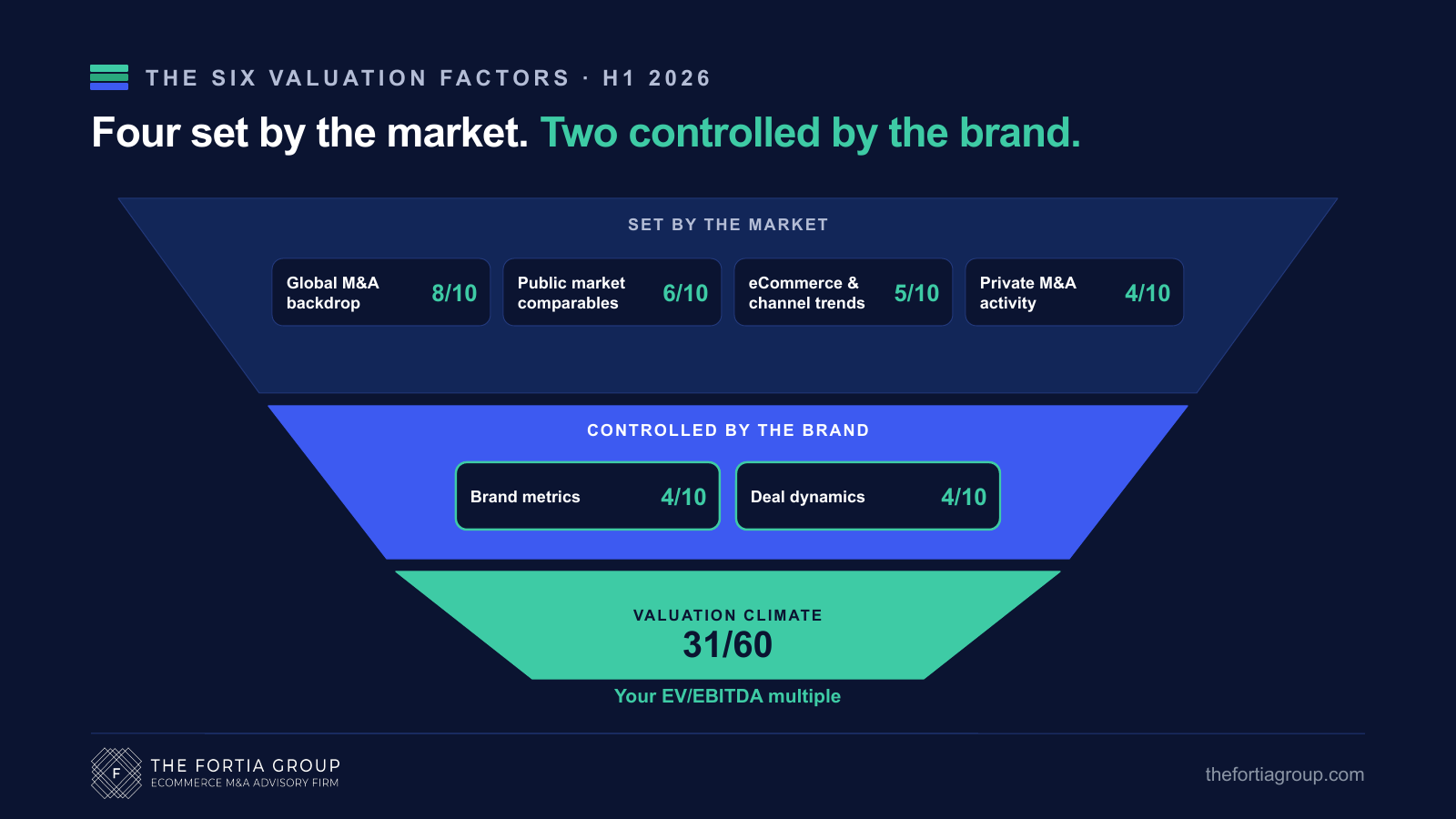
Most eCommerce-led brands sell for a multiple of adjusted EBITDA. In H1 2026, indicative multiples ranged from 1.0x for distressed marketplace-led brands to 14.0x for best-in-class DTC brands. Where you land depends on six factors: four are set by the market, and two are controlled by the brand.
The enterprise value formula
Acquirors price your business on an EV/EBITDA multiple. The headline sounds simple. The detail is where value is won or lost.
Enterprise Value = LTM Adjusted EBITDA × EV/Adj. EBITDA Multiple
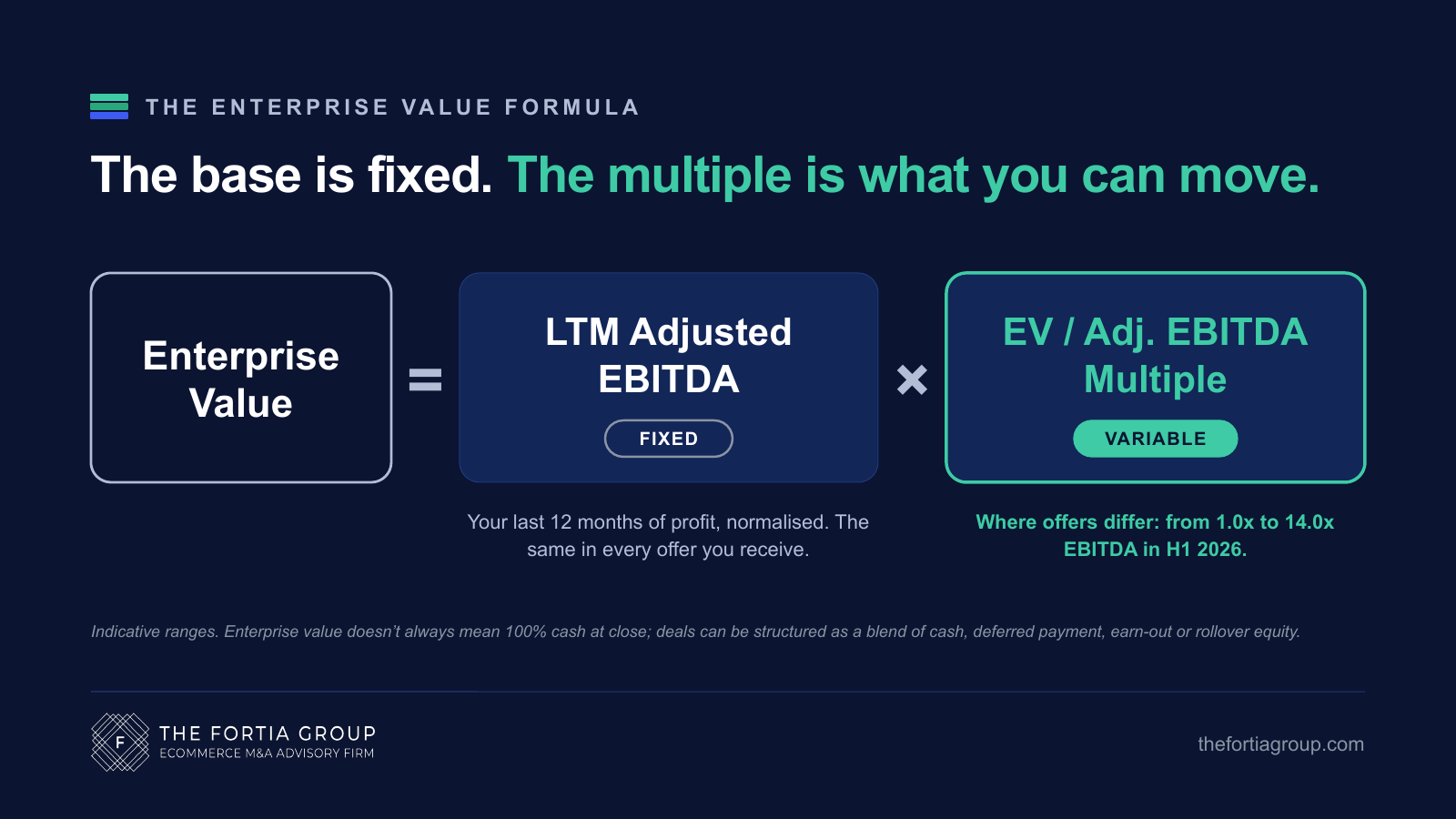
Adjusted EBITDA is the base, and it is fixed. Acquirors start from your LTM reported profit, then normalise it. Founder salary above market rate, one-off legal costs or a discontinued product line can be added back. Every add-back must be documented and defensible, because acquirors will test each one in diligence. That base is the same in every offer you receive.
The multiple is variable, and it is where offers differ. It reflects how confident an acquiror is that today’s profit will continue and grow. Growth, margins, retention, channel risk and buyer competition all push it up or down. The type of acquiror matters too, because each one models valuation and future growth differently.
Enterprise value doesn’t always mean 100% cash at close. Valuations can be structured as a blend of cash, deferred payment, earn-out or rollover equity. Two offers at 6x can deliver very different cash at close, so compare offers on upfront cash, deferred amounts, earn-out conditions and debt-like items, not on the headline number alone.
Revenue still matters. It signals scale, category position and which acquirors will take a meeting. But it is not what they pay for.
Where multiples sit today
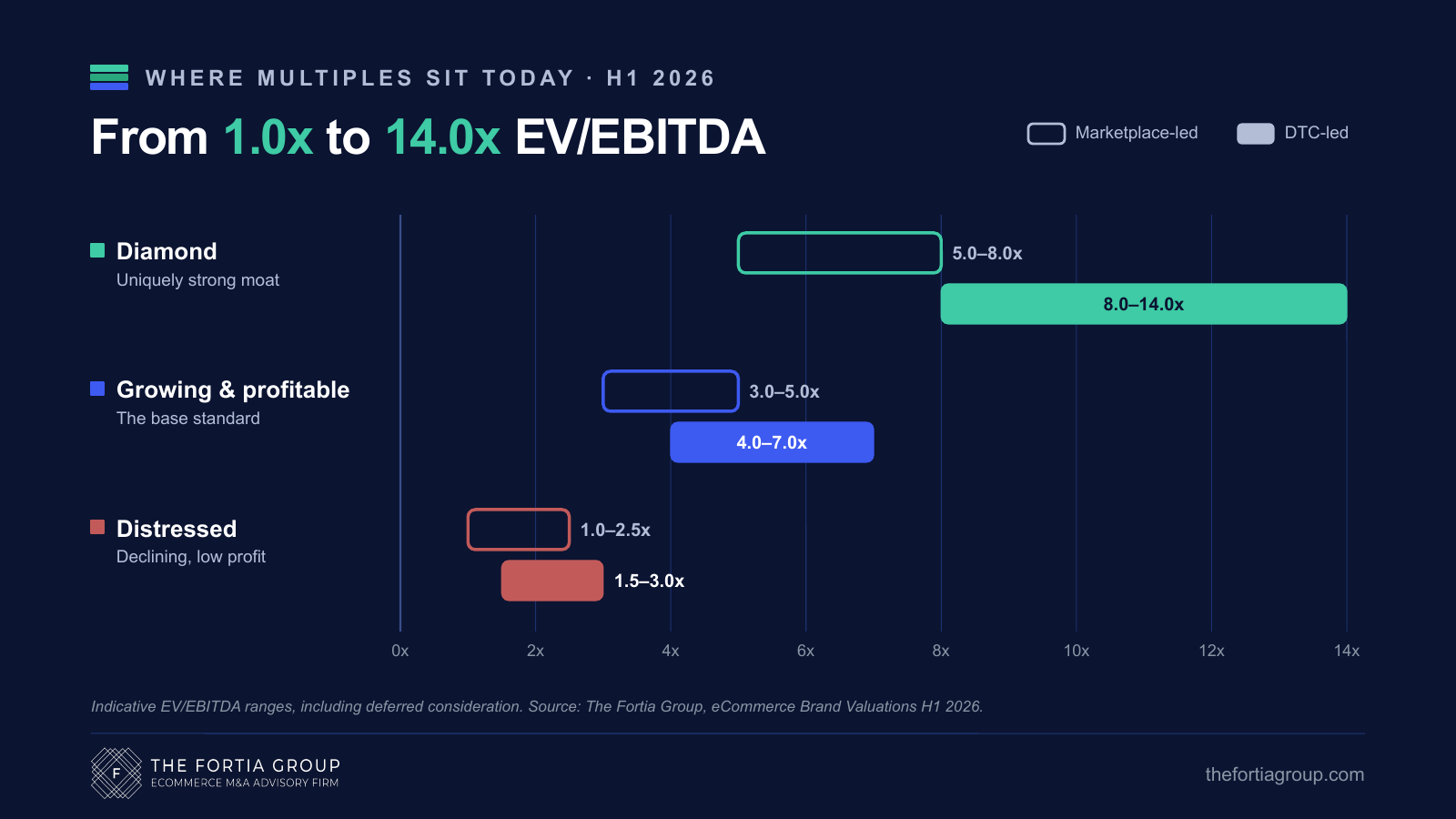
The spread between the weakest and strongest brands is wider than most founders expect: from 1.0x to 14.0x EBITDA in H1 2026.
| Asset tier | Marketplace-led EV/EBITDA |
DTC-led EV/EBITDA |
|---|---|---|
| Diamond | 5.0x–8.0x | 8.0x–14.0x |
| Growing & profitable | 3.0x–5.0x | 4.0x–7.0x |
| Distressed | 1.0x–2.5x | 1.5x–3.0x |
Source: The Fortia Group, eCommerce Brand Valuations H1 2026. Indicative ranges, including deferred consideration.
Two patterns stand out. First, quality tier matters more than anything else: moving from distressed to growing and profitable can more than double your multiple. Second, at every tier DTC-led brands earn a premium over marketplace-led brands, and that premium widens at the top. A DTC brand owns its data and its customer, and has more control over competition and fees.
Distressed. These brands show declining revenue trends and low profitability. Often there is a weakness elsewhere too: brand IP that is hard to protect, a narrow product portfolio, or customers who buy once and don’t come back. Acquirors see turnaround risk and price it in.
Growing and profitable. These are healthy businesses that are growing and making money. They have a moat, and they represent the base standard for a good valuation.
Diamond. A step above. Diamond brands have a uniquely strong moat: protected IP, a loyal customer base and above-average contribution margin. This is where acquirors compete hardest.
And don’t wait for 2021 to come back: those peak multiples are unlikely to return.
Health scores for the six valuation factors
The Fortia Group scores the market on six factors. In H1 2026 the valuation climate came to 31 out of 60, up from 21 out of 60 in our previous report: a market where deals close, but only for brands that earn acquiror conviction.
Some context on the backdrop. 2023 was the worst year for M&A in around 30 years. Global M&A has since rebounded to $2.5tn in H1 2026, up around 40% year on year, and is on pace to rival 2021. However, the rebound is driven by megadeals: deals above $10bn grew 97% in value, while $100M–$1bn deals grew only 7%. Acquirors remain risk-averse further down the market.
| Factor | Controlled by | H1 2026 score | What we are seeing |
|---|---|---|---|
| Global M&A backdrop | Market | 8/10 | After 2023, the worst year for M&A in around 30 years, global M&A rebounded to $2.5tn in H1 2026 (up ~40%). The recovery is driven by megadeals. |
| Public market comparables | Market | 6/10 | The public DTC median is back to 15.3x EV/EBITDA, up from sub-10x in 2022–25. Premiums go to profitable, differentiated brands with scale. |
| eCommerce and channel trends | Market | 5/10 | Agentic commerce and TikTok Shop open new growth. Tariffs and DTC acquisition costs (up 24.7% year on year) make execution harder. |
| Private M&A activity | Market | 4/10 | eCommerce M&A grew 12.8% in 2025 while total consumer M&A fell 18.9%. Acquirors are selective and focused on profitable brands with clear strategic fit. |
| Brand metrics | Brand | 4/10 | eCommerce-led brands have faced profitability strain since COVID. Rising acquisition costs and fluctuating supply chain costs make sustainable growth harder to show. |
| Deal dynamics | Brand | 4/10 | It’s a buyer’s market, and current deal structures favour the buy side. Running a competitive auction process is crucial to win back control on the sell side. |
| Valuation climate | 31/60 | Up from 21/60 in our previous report. | |
Source: The Fortia Group, eCommerce Brand Valuations H1 2026.
The message for founders is clear. The macro picture is the strongest it has been in years (although largely propped up by megadeals), yet the two factors brands control score lowest. That is the opportunity.
You cannot time the market precisely. But you can make sure your business and your process are ready to take advantage when you want to run an exit process.

Lever one: the brand metrics that move your multiple
Brand metrics are the single biggest variable you control. They are also the hardest to fix quickly, which is why preparation should start two to three years before a sale.
One principle sits behind every metric: acquirors underwrite what they can model. Uncertainty is priced as risk. Every data gap means a lower multiple, more earn-out, a retrade later in the deal, or in some cases it can kill the deal entirely.
The two golden metrics
1. Contribution margin. We often refer to this as CMIII: net revenue less direct costs and marketing costs. Direct costs cover fulfilment, distribution and any channel-related costs, so CMIII is essentially everything before group-level opex. Its health tells an acquiror what it costs you to make your product and get it to the customer, and what profit is left.
Gross margin (net revenue less cost of goods sold) is the foundation. To reach a 15–20% adjusted EBITDA margin, we believe you should be targeting gross margin above 70% and a CMIII margin of 25–30%.
2. LTV:CAC. The question acquirors ask is simple: when you acquire a customer, how much value can you derive from them? It shows whether you rely on buying customers or earning them. It also says a lot about your product portfolio. Are customers buying one product, and how strong is its pricing? Are they buying into several products, with good cross-sell and upsell? Are they buying again? An acquiror’s job after the deal is usually to deploy more capital for scale, and LTV:CAC is their first indication of how well your brand is set up to turn marketing spend into growth.
The other metrics acquirors scrutinise
Revenue growth. Acquirors pay for the future, but they price off the past. For most brands under $50M there is an expectation of year-on-year growth. Acquirors want to see patterns and a strategy behind that growth: growth you can explain, that is not here today and gone tomorrow, and that is not propped up by a wave of new product launches or by buying customers at all costs.
Owned demand and retention. Customer acquisition costs are rising significantly for eCommerce-led consumer brands, and many brands have to build awareness across marketplaces, social media and Meta at the same time. Acquirors want to see that you acquire customers efficiently, with real strategy behind it. They also want proof that the brand capitalises on those customers through loyalty: repeat purchase, subscription revenue and engagement.
Channel and product concentration. Acquirors in today’s market are risk-averse. They want to see diversification across multiple channels and multiple products, so that an algorithm change, a fee increase or one weak product line doesn’t put the business at risk.
Founder dependency and succession. If the founder is not planning to stay with the business, acquirors expect a clear, existing succession plan, with a C-suite that can run the business and transfer with it. Otherwise, the founder may be expected to stay on in more than a consulting capacity.
Financial hygiene and forecasting. Acquirors want three or more years of clean monthly P&L and KPIs, seasonality they can see, and a bottom-up, data-driven forecast. Clean numbers do not raise the multiple on their own. Their absence lowers it, and slows diligence.
Lever two: deal dynamics, the value most founders leave on the table
Two identical brands can still sell for different prices because of how they are sold. Deal dynamics are fully optimisable, and they can move outcomes independently of market conditions.
The right mix of acquirors. Strategics, private equity, family offices, roll-ups and search funds each model valuation and future growth differently, so the same brand can attract very different multiples. As an illustration, a brand with $4M of LTM adjusted EBITDA might see:
| Acquiror type | Illustrative multiple | Enterprise value* |
|---|---|---|
| Roll-up | 4.0x–6.0x | $16M–$24M |
| Financial sponsor | 5.0x–6.5x | $20M–$26M |
| Strategic | 6.0x–8.0x | $24M–$32M |
| Same $4M LTM adjusted EBITDA in every offer | Up to $16M difference | |
*Illustrative example only; valuations differ per brand. Enterprise value doesn't always mean 100% cash at close.
Same base, up to $16M of difference. Here is how to capture it.
1. Hire an experienced deal team. Make sure you are covered on the sell side from a legal, an M&A advisory and a tax perspective. Together, these three advisers help maximise both enterprise value and the money that ends up in your pocket.
2. Run a professional exit process. Prepare a clean data room with all materials and supporting documentation, so acquirors can get to letters of intent easily and move through diligence without losing momentum or price. It is just as important to reach every relevant acquiror. That takes time, relationships and energy from your M&A advisory firm.
This is why an M&A adviser matters. During an exit process, your job as the brand owner is to run a successful business, more than ever. Processes typically take around six months, and any dip in revenue or profitability can create uncertainty or kill a deal entirely. The right team runs a professional process in the background while you keep performing.
The process makes the difference. In a recent Fortia process for UpwardBaby, a high six-figure US Amazon baby brand, a competitive auction generated seven letters of intent.
3. Negotiate structure, not just price. Enterprise value is one thing; money in your pocket is another. Enterprise value is the headline ticker price for your business, but structure really matters. How much is upfront cash at close versus earn-outs or deferred payments? How are the deferred components structured? Is there rollover equity, and what is expected of the founder after the acquisition? Warranties, indemnities, holdbacks and working capital targets all need to be negotiated to maximise the cash you receive.
The highest ticker price is not always the best deal. The devil is in the detail.
What this means for your exit timing
The best time to sell is while performance is strong and still growing, not after a decline. Acquirors pay for momentum. A brand that goes to market on a rising trend negotiates from strength; a brand that waits for a down quarter negotiates from weakness.
Three principles we share with every founder:
- The day you buy is the day you sell. Start preparing your exit two to three years out. That gives you time to strengthen the metrics acquirors reward, clean up your financials and build the right relationships.
- Flirt, date, marry. Build relationships with acquirors long before a process. When the moment comes, you are choosing your acquiror rather than accepting one.
- Ask and you shall receive. Get redacted market feedback from acquirors early, so you know what they will scrutinise before it costs you.
Above all: get bought, not sold. Run a business you would be proud of whether or not it exits.
Next steps: truly understand your valuation
The Fortia Group works exclusively with eCommerce-led consumer brands in the $20M–$200M range, and only on M&A. Our three co-founders bring Wall Street investment banking, CFO-level financial diligence and hands-on experience scaling consumer brands, and they lead every deal personally.
If you are thinking about an exit in the next two to three years, or simply want to know where you stand:
Request a free, confidential valuation assessment
Get an independent view of your brand’s value and the levers that would move it, at no cost.
Book Your Free Valuation →Join our H2 2026 eCommerce Brand Valuations webinar
Get the updated six-factor scores, the latest EV/EBITDA ranges and views from active acquirors.
Register For The Webinar →Register your interest in The Acquiror Summit 2027
At Convene, 1 Liberty Street, New York, where founders meet strategics, PE, family offices and roll-ups face to face.
Register Your Interest →Valuation ranges in this article come from The Fortia Group’s H1 2026 eCommerce Brand Valuations research and include deferred consideration. They are indicative and illustrative, and not a valuation of any specific business. Enterprise value doesn’t always mean 100% cash at close.